
The project has since been complete as of 2023, end of my undergrad program. As such, a general overview of the project can be given as part of my portfolio. Unfortunately I was not able to refine the project enough to create a thesis or working, actuated prototype but there’s a lot of things I learned along the way. The process I would’ve documented in a report will be summarized here.
Prior, I had been working with UCR’s ARCS lab for the past couple of months as an assistant for a PhD student. I got involved because last summer I did a field research job under the same building and all of us peeked inside the robotics lab when we heard drone testing go off. Even though I was really passionate about robotics, quarantine pushed a lot of my plans late into junior/senior year so now was the time to stop bumbling around, head in books, and actually get myself out there.
In January 2023, an opportunity was presented by the PhD candidate. Design a robot testbed for legged robotic locomotion tests. The image that pops into mind is treadmills with obstacles like how they tested MIT’s Cheetah or walking rehabilitation. The budget would come from a mini-grant program offered to undergraduates with their own research project, where they would present at the end of the year for a symposium.
This was the breakthrough moment for me.
The justification was to bring outdoor testing indoors for repeated trials. Instead of the method employed by MIT’s Leg lab to run robots on an outdoor trail, maybe it’s possible to simulate that inside indefinitely.

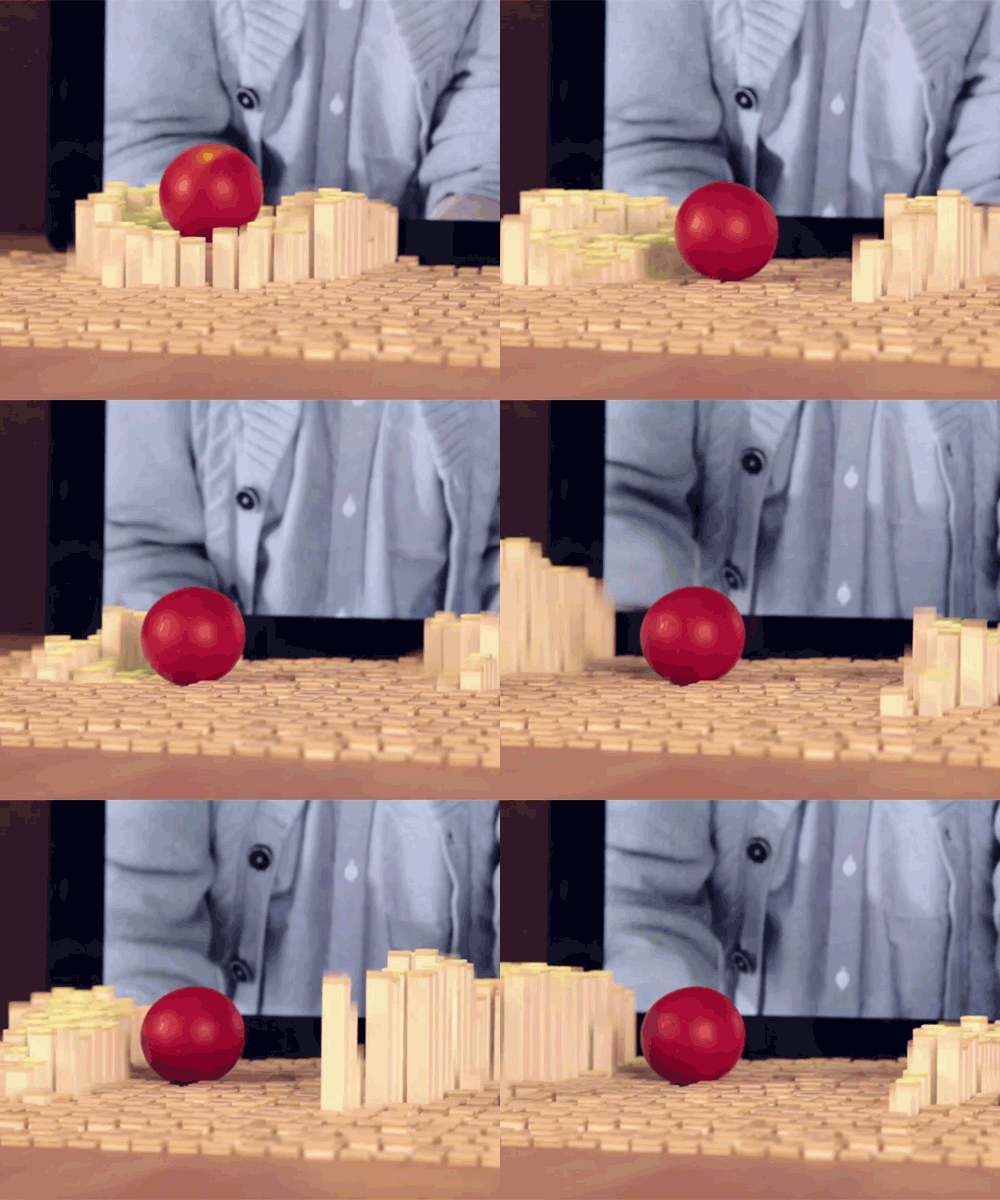
I had stumbled upon shape-changing displays and wondered if there was a way to make them cheaper and modular in X-Y directions, as that was the main limitations with these machines. These displays were limited to research and often were tiny sections of a surface attached to a massive actuator system comprised of expensive hardware.
This project started off to be used in robot testing but quickly expanded for applications in human-computer interaction, rehabilitation, and VR.
Throughout I prototyped with laser-cutting and 3D printing to come up with novel locking mechanisms. To support heavy loads over an extended period of time, a mechanical lock was considered instead of constantly driving a motor (and reduce cost).

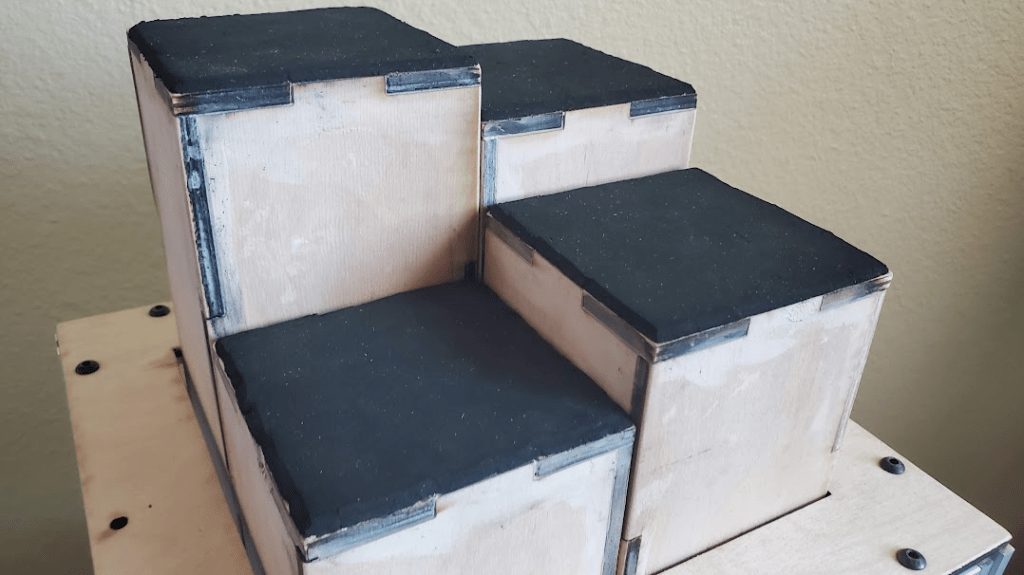
This had some hidden complexity that I was still new to designing for. Actuation was separate from each pin so how can a mobile actuator interface with each pin quickly and reliably? How can it actuate the mechanical lock and keep it open even as the pin moves up and down?
And in general, designing interlocking surfaces. A lot of tolerance measurements and coming up with methods of reducing unnecessary friction or interference. Looking back at the project in 2025, most problems would’ve been solved with machinist tolerances and not using plywood for tight tolerances.
By the end of the project and plenty of nights in my bedroom reiterating prints, I had a small proof of concept of the locking mechanism. No motor actuation but the idea was there.
The magnetic actuation method worked surprisingly well for someone who did not optimize it. If I ever decide to return to this project, I would love to recreate the actuation area using machined cast iron to greatly increase the magnetic flux, instead of operate across a large air gap.

The best part of this project though was the simulation. I did not expect my excitement to be this high to see a virtual agent move across the screen based on a rudimentary control hierarchy and seeing multiple agents adjust accordingly. When I go back to grad school, I’d love to learn more about this topic or maybe even talk to the researchers of shape-changing displays I referenced.
You can see that because of the separate actuator/pin setup and locking mechanic, you can have the actuators (blue/purple) follow a subject walking on the surface (red arrow+dot). Heavily inspired by how open-world video games like Minecraft render terrain, prioritizing things you see and a little around you for when you turn. It’s also possible that a subject can walk around an infinitely generating terrain in the small space as the actuators reposition things.
That summed up the last quarter of my senior year. During summer, some undergrads were looking at the prototype and I gave some advice on how to improve it and maybe integrate actuators.
With an individual project on limited experience and extremely tight time constraints, progress was not as far as I hoped. Even if in my own time, I’d love to revisit this project and remake it better.
 kenneth chung / mechameka0 blog
Leave a comment